
Every quality team knows the complaint that keeps coming back. It gets fixed — quickly, sincerely, repeatedly. A part is replaced, a batch is re-inspected, an apology is sent. And three months later the same defect surfaces at another customer, and the whole cycle starts again. The 8D method exists to break exactly that loop: it separates making the customer whole from making the problem impossible, and refuses to close the file until both are done.
This article walks through the Eight Disciplines the way a practitioner uses them — what each discipline is for, what "done" looks like, and the tools that carry the analytical weight: the fishbone diagram, cause categorisation, the past-trouble database and horizontal deployment. It finishes with the failure modes we see most often, and how the complaint ticket and software keep the record honest. If you are still evaluating whether you need a complaint system at all, start with our buyer's guide, What is complaint management software?, or the complaint management pillar guide for the wider discipline.
1. What is 8D — and where does it come from?
8D — the Eight Disciplines — is a structured, team-based problem-solving method for resolving serious problems at root cause. It was popularised by Ford and the automotive industry, where suppliers are routinely required to answer a customer quality complaint with a formal 8D report, and it has since spread across manufacturing and quality management generally. If your customers include automotive OEMs or tier-1 suppliers, an 8D response is often not optional — it is the expected format of your answer.
The method's power comes from three deliberate separations:
- Containment is separated from correction. Protecting the customer today (D3) is treated as a different job from removing the cause forever (D5/D6) — so the quick fix can never quietly become the only fix.
- Cause is separated from blame. The disciplines force the team to prove a root cause with evidence before acting, which is what stops the investigation from ending at "operator error".
- The occurrence is separated from the system. D7 asks not just "why did this part fail?" but "why did our system let it fail — and where else could it?"
For ISO 9001 organisations, 8D is also the most natural way to satisfy clause 10.2 — react to the nonconformity, evaluate the need for action, implement it, review its effectiveness and retain documented evidence. An honest 8D report is that evidence. Our ISO 9001 complaint management page maps the clauses in detail.
2. D0 to D8, discipline by discipline
Different companies number the steps slightly differently — the classic form is D1–D8, with D0 added later as a preparation step. Here is the full sequence as it should actually be worked.
- Confirm the problem justifies an 8D — a systemic or repeat defect, not a one-off service slip
- Take emergency response actions if the customer is exposed right now
- Gather the facts already on the complaint ticket: customer, item, order, description, photos, dates
- Small and cross-functional — the people who know the product, the process and the customer
- One champion with the authority to implement changes, one leader who runs the investigation
- Not a solo assignment: a root cause found by one person tends to be the cause they already believed in
- State the problem in facts: what object, what defect, how many, where found, when, by whom
- Use is/is-not thinking — where the defect appears and, just as importantly, where it does not
- The complaint ticket is the raw material here: the customer's words, the linked item or order, and the attached evidence
- Protect the customer immediately: quarantine suspect stock, screen in-transit material, supply verified-good parts
- Containment is a tourniquet — it stops the bleeding and buys time, and it is explicitly temporary
- Record what was contained and how, so the interim action can be removed cleanly after the permanent fix
- Brainstorm candidate causes on a fishbone diagram, grouped by category (section 3 below)
- Check the past-trouble database first — has this failure mode been solved before? (section 5)
- Test candidates against evidence until one cause explains every fact from D2 — including the is-nots
- Identify the escape point too: why did inspection and controls not catch it?
- Select the action that removes the confirmed root cause — not the cheapest patch over the symptom
- Verify by test or trial that it will actually work before rolling it out
- Prefer error-proofing over instructions: a fixture that makes wrong assembly impossible beats a memo
- Put the corrective action into production and watch the results over real output
- Validate with data that the defect has stopped occurring — then remove the D3 containment
- Update the controlled documents the fix touches: drawings, work instructions, control plans
- Deploy the fix horizontally to similar products, lines and sites that share the same conditions (section 6)
- Formalise permanent engineering or process changes through a change request
- Feed the solved case into the past-trouble database so the next team starts from knowledge, not zero
- Review the completed 8D with the team and the champion; acknowledge the work honestly
- Close the customer loop — the complaint ticket is verified and released by a supervisor, not self-closed
- Capture the lessons learned while they are fresh; they are half the value of the exercise
3. Fishbone analysis — organising the suspects
The fishbone (Ishikawa) diagram is the workhorse of D4. The problem statement from D2 sits at the fish's head; the bones are categories of possible cause, and the team brainstorms candidate causes along each bone. The classic manufacturing categories are the six Ms:
- Man (people) — skill, training, fatigue, handover gaps
- Machine — wear, calibration, tooling, maintenance state
- Method — the process itself: sequence, parameters, work instructions
- Material — supplier lots, substitutions, storage and handling
- Measurement — gauge accuracy, inspection method, sampling
- Mother nature (environment) — temperature, humidity, dust, vibration
Two rules keep a fishbone honest. First, a brainstormed cause is a suspect, not a verdict — every candidate must be tested against the D2 facts, and most will be eliminated. Second, keep asking why down each bone (the five-whys habit): "operator missed the step" is not a root cause; "the work instruction shows the old revision and the step is easy to skip" is getting closer to one.
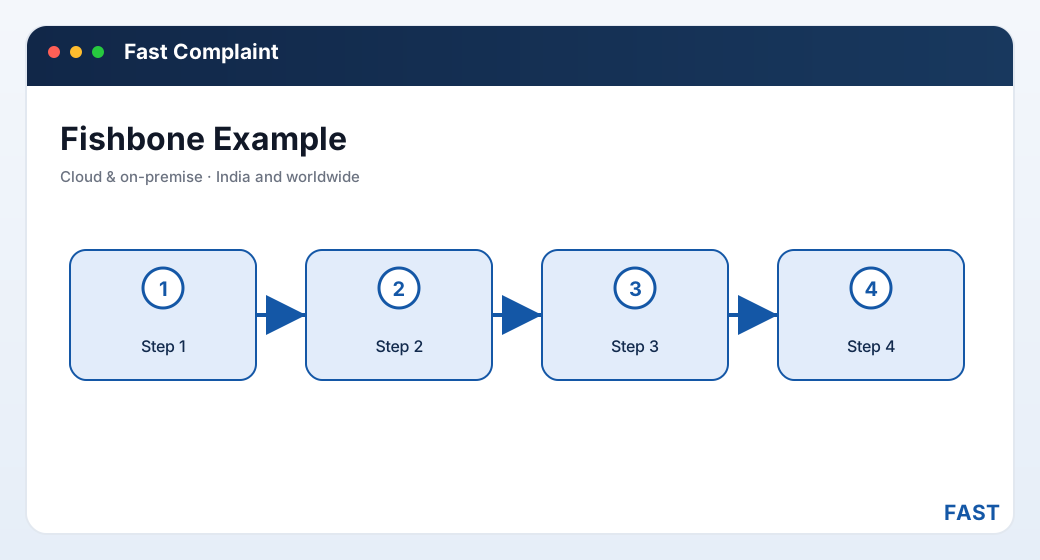
The fishbone does not find the root cause for you — it stops the team from anchoring on the first plausible one by forcing every category of cause onto the table.
In Fast Complaint Software, the fishbone is a working screen, not a wall poster: causes are captured and categorised against the investigation, and cause categories and specifications are maintained as master data — so the same vocabulary is used across every 8D, which is what later makes cause-wise analysis possible. See 8D root cause & CAPA for the full toolset.
4. CAPA — the outcome the disciplines produce
8D and CAPA are often used interchangeably; they are not the same thing. CAPA — Corrective and Preventive Action — is the outcome. 8D is the disciplined route to it.
- Corrective action is D5/D6: the change that removes the confirmed root cause of the problem that already happened — a process parameter fixed, a tool replaced, a work instruction corrected, an inspection added at the escape point.
- Preventive action is D7: stopping the same cause from producing a problem elsewhere — spreading the fix to similar products and processes, and formalising the change so it cannot regress.
The formalisation matters more than teams expect. A fix that lives in one supervisor's memory dies with their transfer. This is why the 8D toolset includes a change request — the corrective action drives a controlled engineering or process change, with the paper trail leading back to the originating complaint. When an auditor, or the customer, asks "what did you change, and can you prove it?", the answer is a document chain, not a recollection.
5. Past-trouble reuse — never solve the same problem twice
The most underrated tool in the whole 8D kit is the past-trouble database — the searchable record of previous problems, their confirmed root causes and their countermeasures. It earns its keep twice in every investigation:
- At D4, it is the first place to look. If a similar failure mode was root-caused two years ago, the team starts from a verified hypothesis instead of a blank fishbone — and often discovers the old countermeasure was never applied to this product line, which is itself the finding.
- At D7, it is where the finished case is deposited: problem, root cause, corrective action, lessons learned. The database only works if closing an 8D requires feeding it.
Without a past-trouble discipline, organisational memory lives in the heads of two senior engineers, and every retirement is a quality regression. With it, the complaint desk becomes a compounding asset: every solved problem makes the next investigation shorter.
6. Horizontal deployment — spreading the fix
Horizontal deployment is the D7 practice of applying a confirmed fix beyond the place where the problem was found. The reasoning is simple: root causes are rarely unique to one part number. If a sealing process produced a leak on product A, the same process probably serves products B and C — and the same latent defect is sitting in them, waiting for a customer to find it.
Worked properly, horizontal deployment is a checklist exercise: list every product, line, machine and site that shares the root-cause conditions; apply or adapt the countermeasure to each; record what was deployed where, and what was consciously excluded and why. That record matters — the difference between "we fixed it everywhere" and "we think we fixed it everywhere" is exactly what a customer quality engineer will probe on their next visit.
In Fast Complaint Software, horizontal deployment is a tracked step of the 8D toolset rather than a good intention: the deployment is recorded against the investigation, alongside the fishbone, the problem-solving report and the change request, all referenced back to the originating complaint ticket.
7. Where teams fail at 8D
8D fails far more often in execution than in concept. These are the patterns worth checking your own process against:
- Containment becomes the fix. The customer stops complaining after D3, the pressure drops, and the investigation quietly dissolves. The defect is still being produced — you are just catching it at extra cost, forever.
- Root cause by opinion. The loudest or most senior voice names a cause, the fishbone is filled in afterwards to decorate the conclusion, and the "fix" addresses the wrong thing.
- The investigation stops at the operator. "Retrain the operator" is the most common non-answer in quality. The disciplined question is why the process allowed the error — and why the controls did not catch it.
- 8D as paperwork after the fact. The form is completed to satisfy the customer's format, days after decisions were made without it. The report is fiction with signatures.
- No verification of effectiveness. The action is implemented and the file is closed the same day. Nobody looks at the next month's output to confirm the defect actually stopped.
- No horizontal deployment. The fix stays on the one line where the complaint originated; the sibling line generates the identical complaint next quarter — as a brand-new ticket, investigated from scratch.
- Nothing feeds the past-trouble database. Each 8D is an island. Ten investigations produce ten reports and zero organisational learning.
- Self-closure. The person who worked the complaint decides it is resolved. Without an independent verification step, weak fixes sail through.
Notice that almost every failure mode above is a record-keeping and follow-through failure, not an analytical one. Teams are usually capable of finding root causes; what they lack is a system that refuses to let the process stop halfway. That is exactly where software earns its place.
8. The complaint ticket as the anchor — and how software carries the record
In practice, the 8D does not start in a meeting room. It starts when the complaint lands — and the quality of D1/D2 depends almost entirely on the quality of that first record. This is why the complaint ticket is the natural anchor for the whole investigation:
- D1/D2 live on the ticket. In Fast Complaint Software, the complaint is logged against the customer, linked to the item or order it concerns, with the problem description, category, priority and photo evidence attached — an auto-numbered document with dates and a full audit trail. When the 8D team convenes, the problem description is already facts, not folklore.
- D3 is visible workload. Containment actions and their owners are recorded as actions on the ticket, followed up against due dates rather than remembered.
- D4–D7 escalate into the quality toolset. A complaint that reveals a genuine defect escalates into the structured 8D — fishbone diagram, problem-solving report, cause categorisation, past-trouble database, horizontal deployment and change request — with everything referenced back to the originating ticket. Complaint handling stays standalone-capable; the 8D depth is there when the defect is real.
- D8 is a controlled release. Closure is a supervisor's verification step — the Release Complaint approval — not a self-set status. The status history is retained, which is what makes the record defensible in an ISO 9001 audit under clauses 8.7 and 10.2.
- The learning stays queryable. Because tickets carry categories, customers and items, complaint data slices for Pareto-style trend analysis — and Dhruv AI extends this with plain-English questions over your complaint data in a read-only sandbox, clustering of complaint and quality remarks into labelled themes, and a complaint view that surfaces the 8D CAPA record — root cause, corrective actions and lessons learned — alongside the ticket.
From complaint ticket to fishbone to verified closure — one traceable record
Fast Complaint Software anchors D1/D2 on the complaint ticket and carries the investigation through the structured 8D toolset — fishbone analysis, problem-solving report, cause categorisation, past-trouble database, horizontal deployment and change requests — with supervisor-verified closure and the full trail retained.
9. Frequently asked questions
Watch an 8D run end to end on screen
A 30-minute demo — complaint ticket to fishbone to past-trouble lookup to verified closure, on your kind of defect.