From intake to root cause to customer feedback — one numbered ticket, one lifecycle, one audit trail. No lost emails. No spreadsheets. Just complaint handling that closes the loop.
When customer complaints live in email, phone notes and WhatsApp, things get missed, nobody owns them, and customers end up chasing you.
A call, an email, a WhatsApp message — complaints arrive in a dozen places and some are simply never logged or acted on.
Without a clear owner and a due date, complaints sit around while everyone assumes someone else is handling them.
You fix the symptom but never the root cause, so the same complaint comes back — and the customer has to chase you again.
It's one place where every customer complaint becomes a numbered ticket — with a category, an owner and a due date. Your team captures it, assigns it, fixes the real cause, and closes it with the customer's feedback on record. Nothing gets lost, and every complaint is seen through to the end.
Log complaints from phone, email or WhatsApp in seconds — each one gets its own numbered ticket so it can never be forgotten.
Hand each ticket to the right person with a clear due date, and see at a glance what's open, what's overdue and what's done.
Find the real cause with a simple 8D/CAPA check, fix it for good, and have a supervisor verify before the ticket is closed.
Every complaint is logged, owned and closed — no more lost emails or forgotten follow-ups.
Clear owners and due dates mean complaints get answered and closed on time, every time.
Capturing feedback and closing the loop turns upset customers into loyal ones who trust you.
Every complaint, cause and fix is on record — so ISO 9001 audits become quick and stress-free.
Fast Complaint Software carries every ticket through one controlled lifecycle, from first contact to verified closure and customer feedback.
A complaint can arrive by phone, WhatsApp, email, or direct entry — and every one of them lands in the same place. An inbound IVR call auto-creates or attaches to a ticket. The handler selects the customer, links the item or order the complaint concerns, describes the problem, and attaches evidence such as defect photos. The system issues an auto-numbered ticket with a category, a priority, and a lifecycle status — and from that moment, every action on it is on the record.
Read more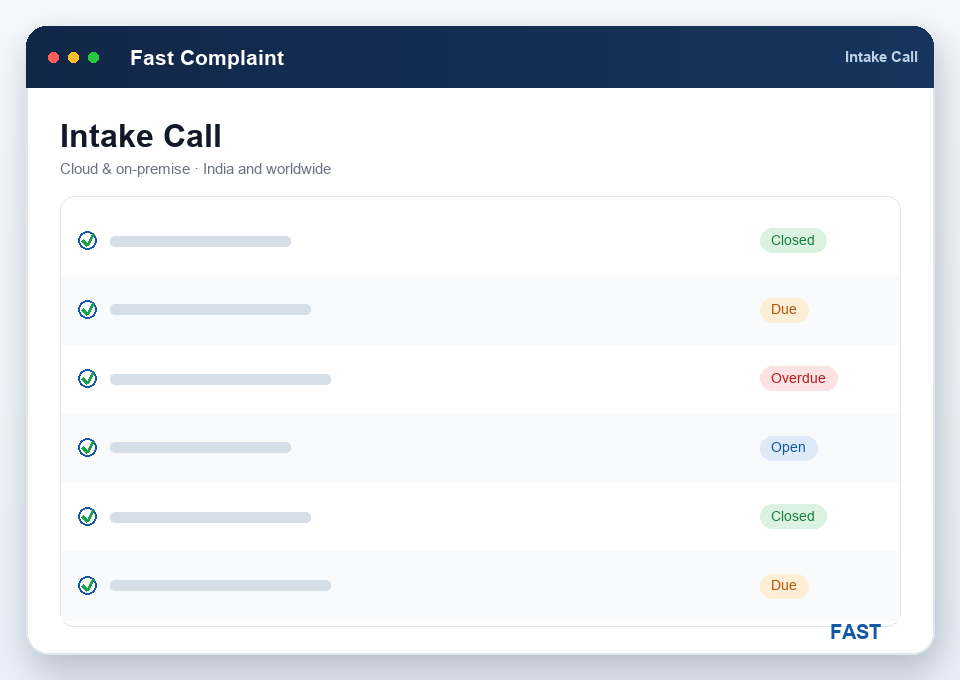
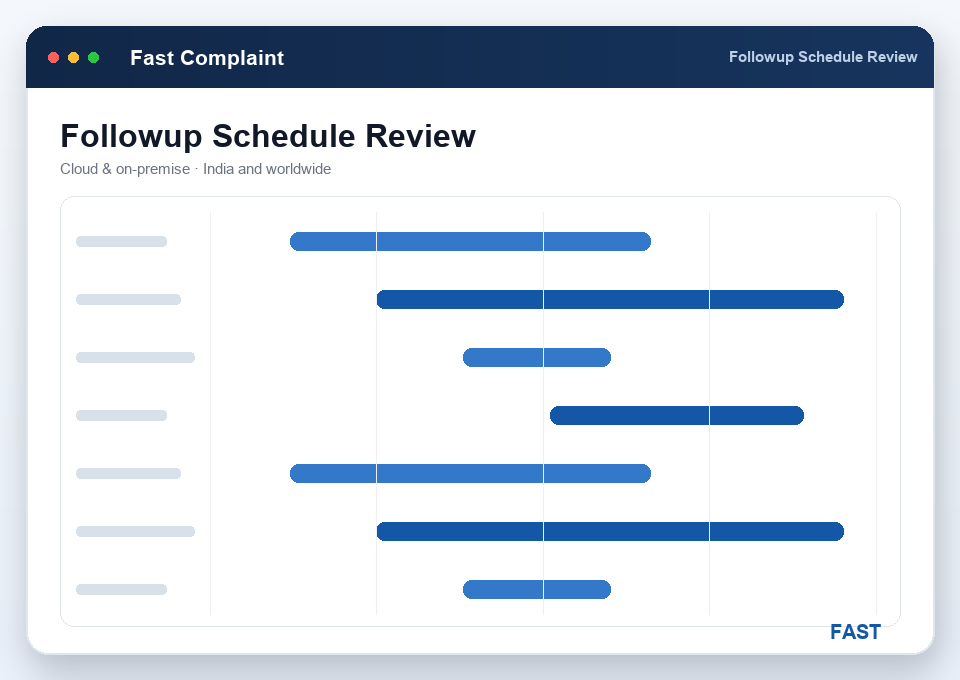
Priority and due date set the SLA expectation the moment a ticket is created. The follow-up scheduler is the operational heart of the system: every pending ticket carries its next follow-up date, and the pending-versus-completed views show the open workload and its ageing at a glance — by owner, by category, by customer.
Every assignment records who is responsible, what action they took, and what the result was. Email, SMS, and WhatsApp notifications prompt owners when follow-ups fall due and escalate tickets that go overdue — so nothing sits unanswered in an inbox while the customer waits.
When a complaint reveals a real product or process defect, it doesn't end with an apology — it escalates into a structured 8D corrective-action investigation. The complaint ticket anchors the customer-facing side (D1/D2); the investigation carries the analysis: fishbone root-cause diagrams, cause categorisation, and a Problem Solving Report that documents the whole chain from symptom to permanent fix.
The Past Trouble Database lets the team reuse root causes and countermeasures from similar complaints instead of solving the same problem twice. Horizontal Deployment spreads the confirmed fix to similar products and lines, and a Change Request formalises the engineering or process change — exactly what ISO 9001 clause 10.2 asks you to evidence.
Read more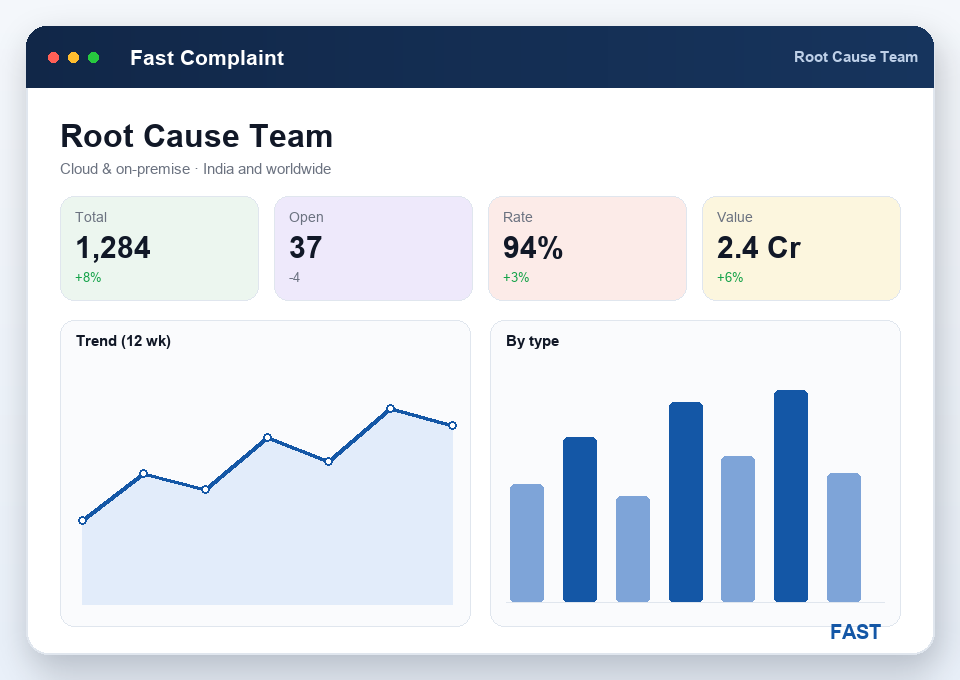
A resolution isn't the end of the ticket. The controlled Release Complaint step means a supervisor verifies the action and its result before anything closes — the handler cannot self-close. A chargeable service ticket raises its service invoice on completion, through the same engine your billing runs on.
Then the loop actually closes: feedback is scheduled against the resolved ticket, captured with ratings, and chased with feedback-due alerts. Everything rolls up into the Customer Satisfaction Index and customer-wise feedback analysis — so management sees not just how fast complaints close, but whether customers walked away satisfied.
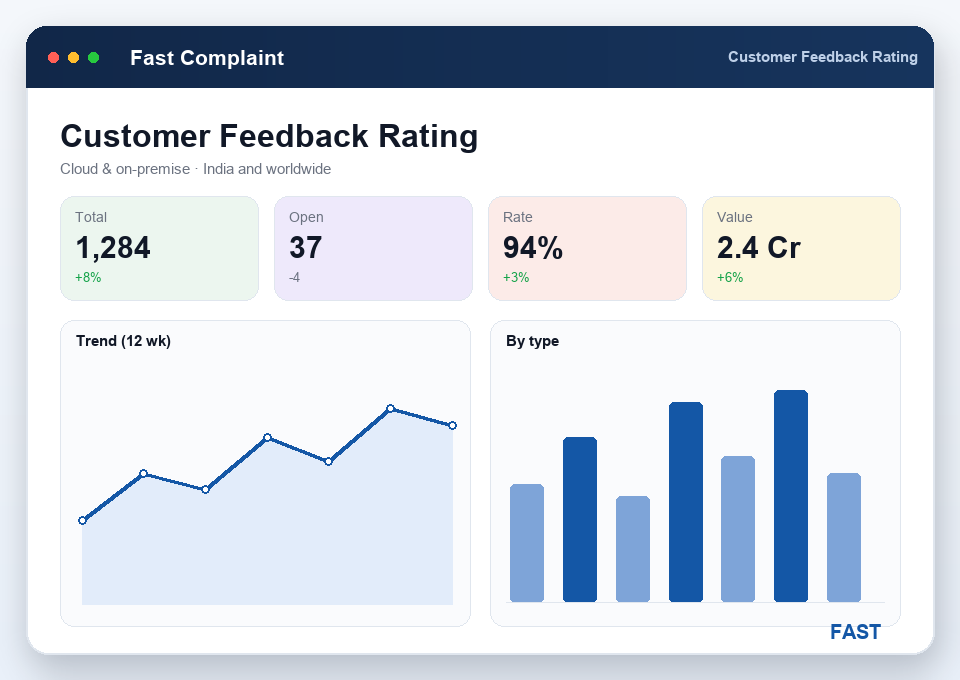
Fast Complaint Software ships with the dashboards and MIS reports a complaint desk actually runs on — ageing, pending workload, satisfaction analytics — plus Dhruv AI, our own AI layer for the questions a fixed report can't answer.
The complaint control tower — open vs closed, ageing, responsibility and actions, and ratings, all on one screen for the manager who owns the number.
Service-ticket workload, engineer scheduling, and status — installation, breakdown, and after-sales visits followed from request to completion.
Every open ticket with its next follow-up date and ageing against the due date — the operational heart of SLA management, reviewed daily.
Ticket summary and periodic history MIS — complaint volumes, statuses, and outcomes over any period, ready for the management review meeting.
Feedback MIS rolls every captured rating into a single satisfaction index, plus customer-wise detail feedback to see exactly who is unhappy and why.
The open workload against the closed record — filtered for complaints or service tickets — so ageing and backlog are visible before customers escalate.
Because every ticket carries a category, a customer, and a linked item, complaints slice by all three — Pareto-style trends that show where defects cluster.
Dhruv AI, our own AI engine, clusters complaint remarks into recurring themes with 8D root-cause data behind each cluster, and generates plain-language insight summaries from your dashboards.
"Which customer raised the most complaints this quarter?" Dhruv AI turns the question into a safe, read-only query and answers with the data and a summary.
Fast Complaint Software is one of 12 integrated Fast Technology products built on a single platform. It shares the same customer master as Fast CRM, escalates real defects into Fast Quality's 8D engine, and raises service invoices through Fast Billing — zero double entry across systems.
Same customer master, same telephony. Complaints appear on the customer 360 beside enquiries, quotes, and orders.
A complaint that reveals a defect escalates into Quality's full 8D / CAPA engine — fishbone, FMEA, control plans, NCR.
A completed chargeable service ticket raises its GST service invoice through the shared billing engine.
The full superset. Complaints link to the same orders, items, and dispatches your ERP transactions run on.
Equipment breakdown and preventive maintenance reuse the same ticket engine your complaint desk already knows.
Internal audit findings and complaint root causes both feed the same CAPA discipline — one corrective-action culture.
We map your complaint-handling process first — how complaints arrive, who owns them, where they stall, gap analysis. Then we configure Fast Complaint Software to fit your operation. Not the other way around.
Post go-live is not where we disappear. Dedicated support team, multiple channels, monthly review meetings, and patches issued on feedback. We treat support as part of the product.
A warranty failure, a breakdown call, and an audit finding need different handling. Fast Complaint Software serves each with the workflow and terminology your team already uses.
A field failure or returned part is logged against the customer and item, root-caused through 8D, and the corrective action fed back into the product and process.
Installation, breakdown, and preventive-service requests scheduled to an engineer, followed to completion, and invoiced when the work is chargeable.
Clause 8.7 and 10.2 need evidence, not intentions. Every complaint is captured, dispositioned, corrected at root cause, and verified before closure — audit-ready.
Replace the shared inbox with categories, priorities, owners, and SLA dashboards. Every grievance — delivery, billing, product — lands in one queue.
Commissioning, installation, and breakdown calls become service tickets with a schedule and an owner — and warranty claims escalate straight into 8D.
Ageing, SLA, and satisfaction dashboards instead of a spreadsheet — who owns what, what is overdue, and whether customers are actually satisfied.
Complaints arrive on channels you don't control — a phone call, a WhatsApp message, an email. Fast Complaint Software meets them there: cloud IVR auto-logs inbound calls against tickets, WhatsApp automation handles intake and updates, and Dhruv AI reads the whole complaint history for you. Your channels. One queue.
See all integrationsSee how Fast Complaint Software handles your exact complaint workflow. Live demo, your categories, your questions. No generic slideshow.